


17 WYLDE STREET: UNIQUE AND TIMELESS
People often flee from something or to something. So it was with Aaron Bolot (1900-1989), architect of 17 Wylde Street, whose Hebraic heritage meant his family fled from Crimea as a result of Russian persecution in 1911.
Unit 23, 17 Wylde Street is for sale through Jason Boon, Geoff Cox and Joss Reid at Richardson and Wrench:
https://www.rwebay.com.au/8327909/
Bolot was only 11 years-old but like others, his Jewish family chose the farthest civilised country from Europe: Brisbane, Australia. At least the weather was better here, especially in Sydney’s Bondi, where his parents eventually lived. He started work as a clerk but left to win glittering gold medals in architecture from Queensland’s Institute of Architects, presented by the State Governor, Sir Matthew Nathan, for history of architecture, planning and an honours diploma. He was featured as “a young man of achievement “ in The Hebrew Standard of Australasia in 1925.
He designed projects with Walter Burley Griffin, designer of Canberra. Bolot said Burley-Griffin was easy to work with and a visionary.
During this period Art Déco and Moderne design were fashionable, especially with cinemas, which promoted the ‘Hollywood’ aesthetic.
Bolot designed the Ritz theatres in Randwick and Goulburn, the Brisbane Regent, the Regal Theatre in Gosford and Melbourne’s Liberty Theatre, one of the first in Australia to have a “gold fibre” screen suitable for 3-D pictures, a novelty. Moving to Sydney in 1930 he designed the Gosford Regal Theatre. It featured the avant-garde, streamlined Moderne Style using curves and included a “crying room” where patrons could retire to during the most romantic or emotional scenes.
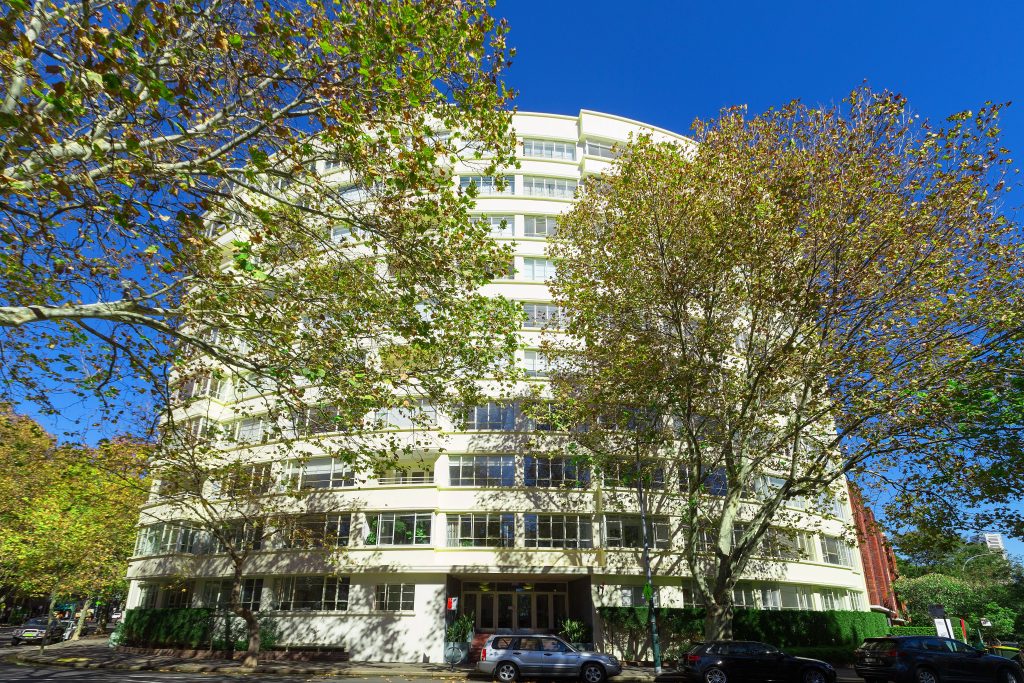
In 1938 he designed Ashdown, a modest Moderne Style, curved window apartment block at 96-98 Elizabeth Bay Road. In 1966 he designed Woollahra’s Jewish Neuweg Synagogue of which he was a member but in 1948 he designed 17 Wylde Street, completed in 1950, a landmark building domination its site.
It was completely unique for its time. It had no name: its number alone sufficed for its identity which was frosted into the entrance doors using its own unique design font.
It was not a company title but a Community Cooperative title, an early form of strata, as it still is, which enabled owners to have a stronger say in its management but still allowed banks to lend money to owner-occupiers. Only in 1945 did it became legal for building societies to lend money to such buildings. Previously, such ownership was restricted to company title buildings.
Bolot thus democratised ownership. He changed the way people purchased and lived in their homes.
Number 17 has the touch of design genius. Its facade is almost all glass. Apartments have huge panoramas. All have an abundance of natural light facing north for winter warmth and are naturally ventilated. The balcony is accessed from various rooms. Kitchens are designed to minimise walking and originally featured a rarity, a cream telephone. Even the carpet was specially designed. Window frames are steel to reduce maintenance. Apartments are paired and serviced by only one of two lift cores giving the effect of a private entrance. The service cores and kitchen and bathroom are at the rear overlooking the rear court. The garage features a clever turntable to ensure cars left front first (still extant) and petrol bowsers. Many apartments retain their original, French-style, chevron-shaped pine parquet flooring and some retain their cream and black bathrooms with their random “mosaic” tiling pattern.
Bolot pre-empted the apartment boom of the1960s during which over 50% of new dwellings were apartments and he set the style bar high for apartment living.
17 Wylde Street is listed as a site of National Significance. It may be 67 years-old but it’s a timeless design.
By Andrew Woodhouse, Director, Heritage Solutions