


Apartment Barncleuth Square
Apartment 18, 10 Barnclueth Square is for sale through Penny Timothy and Luke McDonell
Real Estate For Sale – 18/10 Barncleuth Square – Elizabeth Bay , NSW
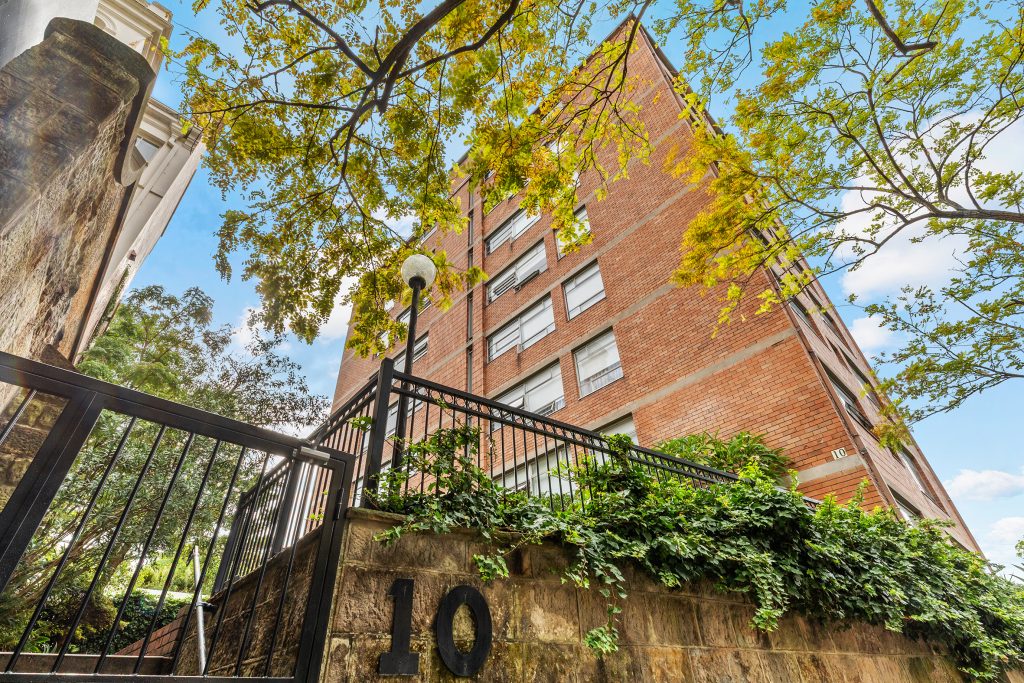
10 Barncleuth Square is an interesting seven storey mid-century brick apartment block. It was built between 10th August 1962 and 18th October 1965 according to Sydney Council’s archives. It incorporates a generous lawn setback, cantilevered front entrance awning and a vertical glass feature typical of the period.
The interior of apartment 10 retains its original tiered pelmets and metal window surrounds.
Barncleuth Square is named after the original former 19th century Barnclueth House on the site. Its massive sandstone block retaining wall now forms the foundation of the apartment block’s retaining wall.
The original Barncleuth was a “trophy house” and later remodeled to become the mansion, Kinneil.
In a learned journal article Judith O’ Callaghan of the University of NSW notes that “Barncleuth was built by James Hume for wine merchant John Brown. It had been one of the first of the “city mansions” to be erected on the recently subdivided Macleay Estate in 1852.
Brown was a colonial success story and Barncleuth was to be both his crowning glory and parting gesture. Within only two years of the house’s completion he was on his way back to Britain to spend the fortune he had amassed in Sydney.
Over the following decades, Barncleuth continued to represent the golden prize for the socially mobile. In the 1880s however, two successive owners, including J. J. Clark’s high profile client Robert Amos, sought to capitalise on their investment by subdividing and selling off most of Barncleuth’s extensive grounds.
Amos also turned his attention to transforming the colonial mansion into a more fashionable statement of success and social standing under Clark’s direction … in distinction to its neighbour, Elizabeth Bay House, Barncleuth was conceived from the beginning as a trophy house; a glamorous commodity to be bought and sold rather than a solid and enduring representation of colonial rank and prestige.”
Today the site contains a former 19th century villa and the 1960s apartment block, part of the continuing evolution of the area.
By Andrew Woodhouse
Heritage Solutions