


BEVERLEY HALL: ”NO EXPENSE SPARED”
Apartment 3, 2 Elizabeth Bay Crescent in Beverley Hall is for sale through Greg McKinley and Andrew Hoggett
Real Estate For Sale – 3/2 Elizabeth Bay Crescent – Elizabeth Bay , NSW
It was built in 1928 and designed by Pitt and Morrow for its owner, Mr W.J. Curtis, a wealthy barrister. Set back from Elizabeth Bay Road with a handsome frontage facing the harbour, its original sales brochure noted “it is away from the noise and bustle of the city with a garden approach … and surmounted with a golden frieze … an elevator renders service with softly illuminated hidden lights … so dignified – so friendly – so comfortable it merits special consideration – it soon becomes irresistible.”
Apartments were originally rented from £5 per week up to £10, some with “3 living rooms, 4 bedrooms and 2 bathrooms”, obviously expansive and expensive. The average weekly male wage in the 1920s was £9. The man was considered the household breadwinner while women generally looked after children and the home.
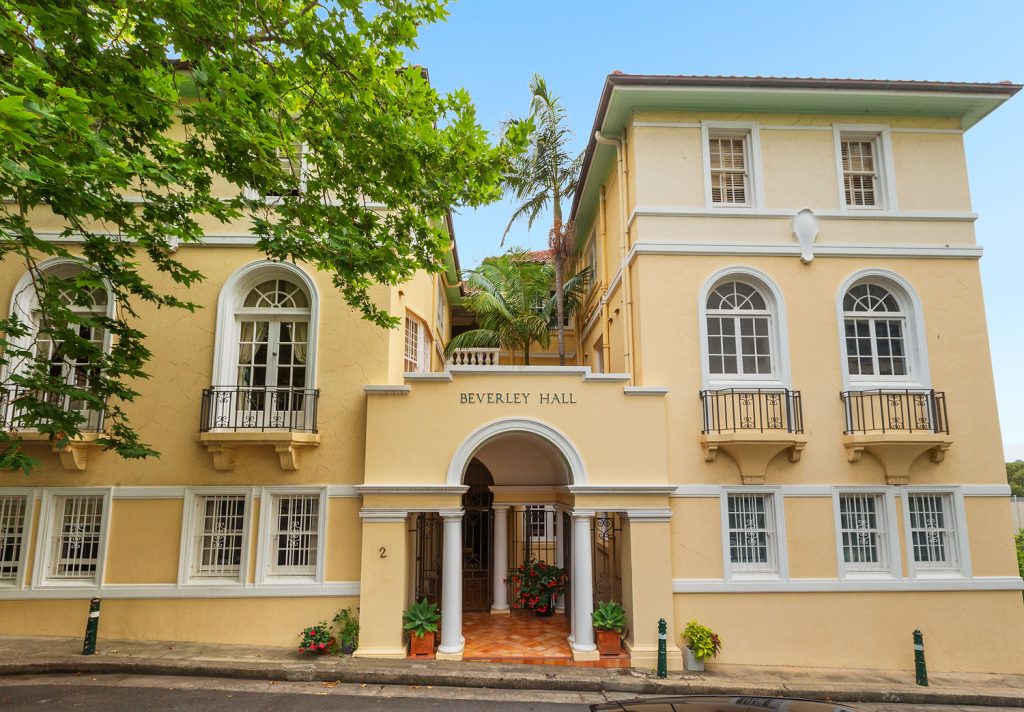
But The Sydney Morning Herald of September 1929 was exuberant, publishing an enticingly large sketch, explaining: “here is a fine piece of modern apartment planning … combining every labour-saving device known to the building world … the quiet dignity of the Italian renaissance facade [and] main entrance attracting immediate attention with its pure beauty of line. The exterior colour scheme has been carefully studied … the buff walls are relieved with the pale orange and green of the eaves and window frames. The water-front facade, overlooking the flagged steps winding to the swimming pool, presents glorious views of the whole of Elizabeth Bay … walls are individually treated with exclusively selected wallpapers and the electric fittings (specially imported) contribute to the atmosphere of refinement … no expence has been spared in the desire to provide an ultra-special home … with lounges overlooking the view, and a living-room, dining-room, smoke-room, entrance hall, three bedrooms and maid’s room, two bathrooms, large kitchen and scullery. Large open brick fire-places are a feature … the kitchens are tiled and enameled with refrigerators installed.”
Beverley Hall is a fine example of the inter-war (1916-1938) Mediterranean Style with vaulted arches, Tuscan columns, a ‘monk’s door’ of solid, engraved cedar, a cool, shaded, tiled entrance, hand-rendered exterior walls and terracotta tiles, all reminiscent of Roman and Spanish villas which evolved in similarly hot climates.
Its interior foyer is richly paneled and its marquetry flooring adds to its character. Ceiling cornices and high ceilings are still retained.
Beverley Hall’s original owner was a colourful character. He was a senior barrister and King’s Counsel or KC who enjoyed a flourishing practise including defamation cases, later becoming an Acting District Court Judge. He also enjoyed a second career in music and as an amateur actor: J C Williamson encouraged him to take up a career on the stage but he declined. He became embroiled in a controversial case of his own when he found his wife dead in the bathroom at their holiday house: she had gone missing and had taken a sleeping pill overdose – apparently – although “there was nothing to indicate the manner in which Mrs Curtis had met her death”, according to detectives quoted in media. No charges were laid.
Today, Beverley Hall retains its patrician position and original style, still embracing its harbour-side setting.
By Andrew Woodhouse
Heritage Solutions