


The Finger Wharf – Profound Local History Right At Our Fingertips
Amid the cut and thrust of modern life, it’s easy to simply “exist” in the immediate present or just the very near future. This can often be at the expense of forgetting the deep history that lies beneath our noses – history that can provide a welcome sense of connection and understanding of the greater continuity of life.
In Potts Point and surrounds, such history runs deep and long. And often, for example, as we sit sipping a coffee at a Macleay St cafe or trying to find a parking spot on Challis Ave or doing some fine dining at Woolloomooloo’s Finger Wharf, it can be heartening to remember such lineage.
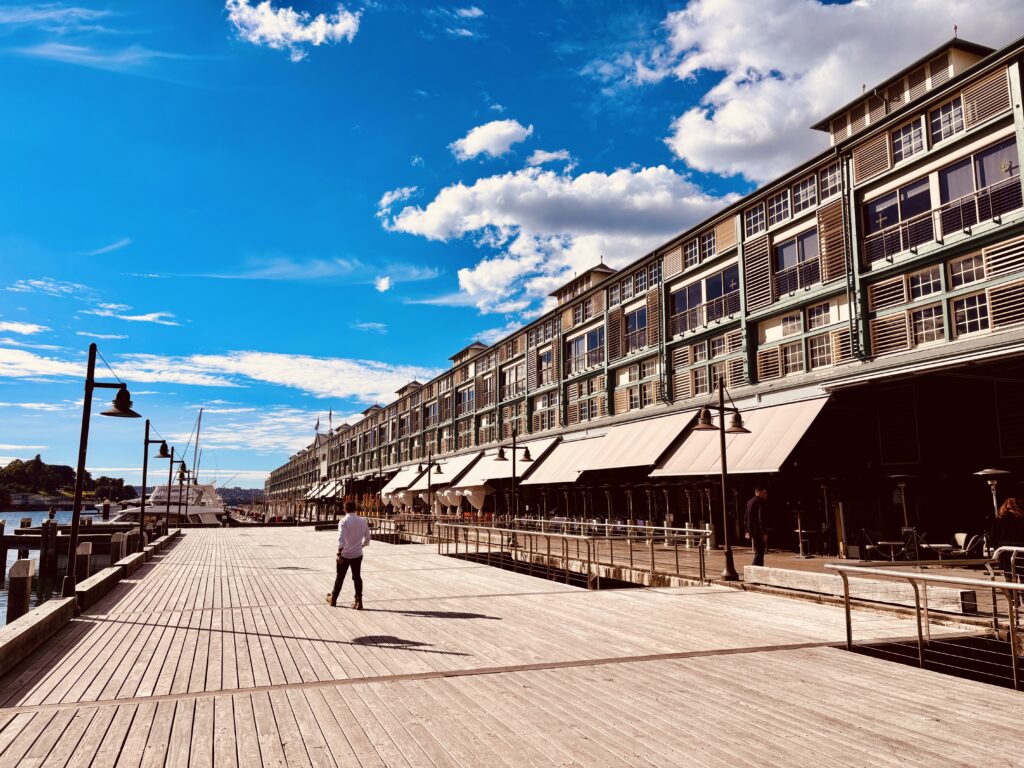
And that latter example is a good point at which to consider such musings. The Finger Wharf may now stand as one of many local landmarks, known for its exclusive restaurants and high-end residential living, but it’s easy to forget the significance of the site. Not merely a “wharf”, it holds an important place in Sydney, and indeed Australian, history.
Built between 1911 and 1915 by the Sydney Harbour Trust and designed by Engineer-in-Chief H.D. Walsh, it combined local building traditions with the most advanced wooden-building construction technologies of its day in an ingenious response to the challenges of commercial shipping.
Dubbed a “cathedral of commerce”, it was a heartland of working Sydney Harbour, where “wharfies” toiled in a demanding environment to keep the economic wheels of the city turning. It was a place of departures and arrivals, joy and heartbreak. Troops sailed for Egypt and Gallipoli from here, while survivors of Changi returned here. Luxury liners carried socialites and millionaires, while migrants stepped ashore to begin new lives in Australia.
The State Government’s 1987 decision to replace the wharf with a new marina caused a storm of protest. The National Trust and the Royal Australian Institute of Architects opposed the demolition while locals were irate. But powerful developers and politicians still pushed for it to be torn down. They called it “the Great Grey Dunny” and advocated “blowing it to bits”, while a government minister said it was “an eyesore”. Clearly they weren’t history buffs.
The wharf thus sat derelict for years while wrangling over its future went on. The wrecking ball was still poised in the early ‘90s when the Building Workers’ Industrial Union placed a “Green Ban” on the site, preventing demolition. Combined with local opposition, this culminated in the government coming to its senses and deciding to conserve the site.
The subsequent renovation preserved all the key elements of the original working wharf while ensuring its survival as a location of significant history. Its survival stands as a reminder not only of Sydney’s maritime history, but also of the determination of the workers, unions and community who fought to preserve one of the city’s most noteworthy landmarks.
Now home to an array of restaurants, including some of Sydney’s finest establishments such as Otto, China Doll, Kingsley’s, Bellevue, and Akti, it is a premium site for Sydneysiders and visitors alike. With luxury apartments which have accommodated the likes of Russell Crowe, John Laws, and Delta Goodrem, it also houses the superb Ovolo Hotel, a deluxe harbourside haven.
So, as we go about the hustle and bustle of our lives in and around Potts Point, it’s worth taking a moment to consider the way past and present can meet – sometimes history is indeed right at our “fingertips”.
Finger Wharf
https://en.wikipedia.org/wiki/Finger_Wharf
By Adam Gibson
Photo by Adam Gibson