


St Mark’s Anglican Church: Much-Loved Icon With a Showbiz Pedigree
The long, winding strip of Darling Point Road is one of the most refined, beautiful and unique thoroughfares in Sydney’s East. Running from New South Head Road at Edgecliff right to the very tip of Darling Point at picturesque McKell Park, this meandering stretch is home to some of the loveliest real estate in the Eastern Suburbs. A historic, tree-lined avenue, it remains a somewhat forgotten pocket of the very best of beautiful Sydney living.
Unique in the fact that it is serviced by just one café, certainly something of an oddity in café-centric Sydney, Darling Point Rd retains a rare village atmosphere, its stately residences, historic buildings and magnificent gardens offering a glimpse into a more genteel era. And standing proudly amid this is St Mark’s Anglican Church, one of the area’s most recognisable landmarks and a place with a fascinating history stretching back almost 180 years.
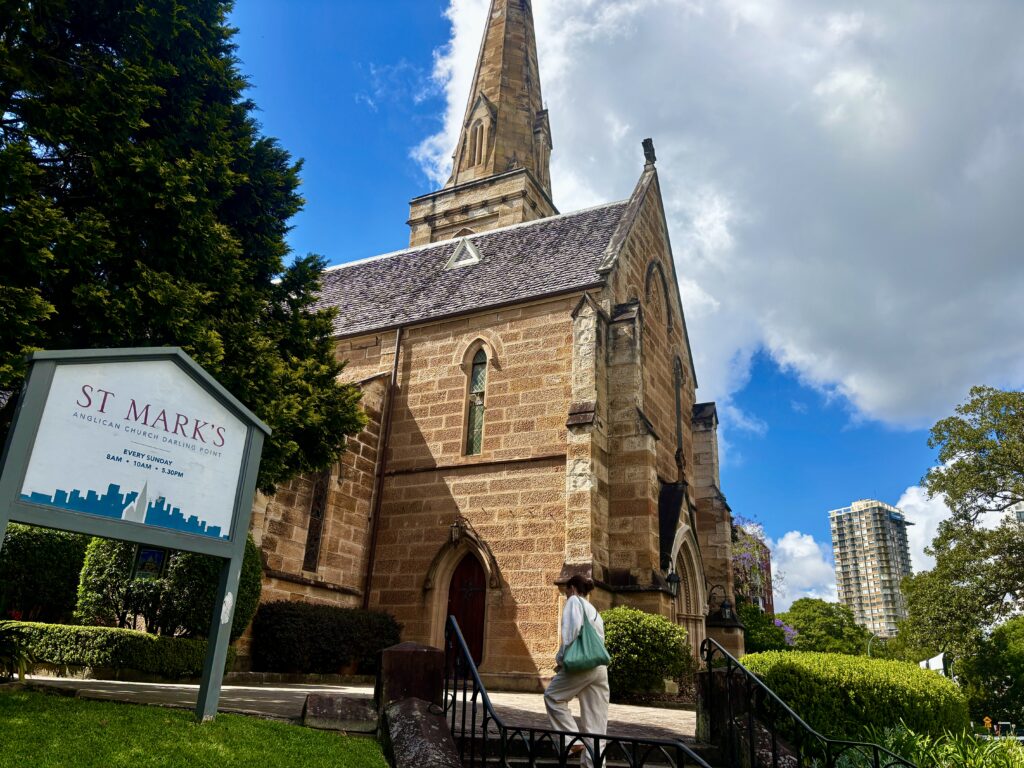
Designed by colonial architect Edmund Blacket, St Mark’s was built on land donated by prominent businessman Thomas Sutcliffe Mort, with its foundation stone laid in 1848. Opening for services in November 1852, the church was constructed in the Gothic Revival style, its sandstone walls, stained-glass windows, timber-shingled roof and soaring spire lending it a distinctly English character. Over the following decades, it became a focal point for the growing Darling Point community, its congregation drawn largely from the wealthy families who occupied the grand estates of the surrounding peninsula.
Perhaps best known in a wider pop-cultural sense as the setting for the famous wedding scene in the cherished 1994 Australian film Muriel’s Wedding, starring Toni Collette, Rachel Griffiths, Bill Hunter and Sophie Lee, St Mark’s has long been regarded as something of the archetypal wedding church in Sydney’s East. And whilst that memorable scene remains one of the highlights of the classic movie, the church was also famously the setting for another rather extraordinary set of nuptials.
On Valentine’s Day in 1984, legendary British singer Elton John married German sound engineer Renate Blauel at St Mark’s, in a ceremony that attracted enormous media attention. Among the guests were some of the biggest names in Australian entertainment, including Molly Meldrum, Barry Humphries and Michael Parkinson, while outside, an estimated 1,500 fans gathered in the rain, hoping to catch a glimpse of the newlyweds.
Such was the excitement that the crowd reportedly pressed against the church’s wrought-iron fence with enough force to bring it down, with Elton subsequently footing the bill for repairs.
Following what was one of the more unexpected weddings in living memory, the celebrations continued at Elizabeth Bay’s equally iconic Sebel Town House, where a lavish reception was held. It was a remarkable occasion, bringing a touch of international showbusiness glamour to the otherwise genteel surrounds of Darling Point, and securing St Mark’s a rather unusual place in Australian popular-cultural history.
Yet beyond the famous weddings, St Mark’s remains a much-loved and active part of the local community, hosting regular services, concerts, musical performances, lectures and social gatherings. Its longstanding Friends of St Mark’s group, established in 1954, continues to bring locals together through a varied calendar of cultural and community events, while its renowned choral music program remains an important part of the church’s identity.
Almost 175 years after its first service, St Mark’s continues to stand proudly along Darling Point Road, its peaceful grounds and beautiful sandstone architecture offering a lovely reminder of the area’s colonial beginnings. A magnificent little piece of Sydney history, it remains very much a living, breathing part of this beautiful neighbourhood.
By Adam Gibson
Photo by Adam Gibson