


Sydney’s Grandest Squat: The Wild Years of Elizabeth Bay House
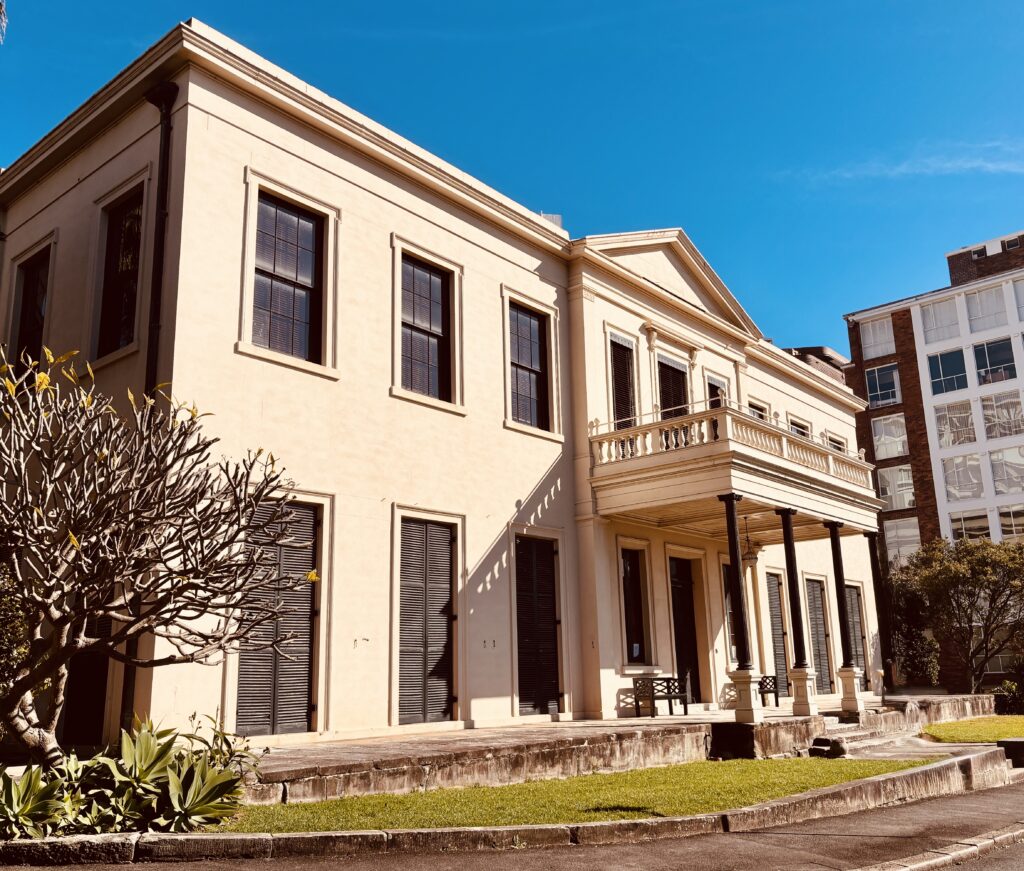
Nowadays, Elizabeth Bay House is rightly known as one of Sydney’s most majestic historic homes, a gorgeously preserved reminder of the city’s early genteel yet simultaneously rough-and-tumble colonial days. But hit the rewind button almost a century and this grand old dame was a very different proposition. During the late 1920s and 1930s, it became an unlikely bohemian enclave, home to a vivid collection of artists and squatters who transformed the once-elegant residence into one of Sydney’s most unconventional addresses.
Built between 1835 and 1839 for colonial secretary Alexander Macleay, Elizabeth Bay House was once, of course, regarded as the finest house in the colony. Set amid sprawling gardens overlooking Sydney Harbour, it was an extraordinary display of wealth and ambition, complete with an elaborate domed saloon and magnificent sweeping staircase. By the late 1920s, however, much of the original Macleay estate had been subdivided and the mansion itself had fallen into a state of crumbling disrepair.
As nearby Kings Cross established itself as a thriving centre for Sydney’s artistic and bohemian community, the increasingly neglected mansion in turn became an informal home and workplace for a collection of painters and other creative types. Artists have always been adept at finding cracks in conventional social structures, and the dilapidated old residence, beautifully perched above the harbour, provided a tempting setting in which to pursue their arcadian artistic dreams.
Among those associated with the house were celebrated portrait painter Sir John Longstaff and younger artists Wallace Thornton and Wolfgang Cardamatis, who took up residence there and became known for throwing lively parties amid the building’s fading colonial grandeur.
According to former curator Scott Carlin, the then-resident caretaker had a fondness for a drop of alcohol or two and was inclined to turn a blind eye to the squatters and their festivities. Accounts describe parties continuing by the flickering light of candle stubs stuck into jam jars, while the drunken caretaker shouted at revellers. The grand old house, once a symbol of colonial respectability, had become a rather different kind of Sydney institution.
And the caretaker apparently possessed something of a flair for storytelling himself. A 1933 newspaper report describes visitors being offered tours of the mansion’s supposed dungeons, coffin chute, hangman’s room and flogging room. In reality, these rather sinister attractions were simply the old cellars, but they certainly added another colourful dimension to the increasingly dilapidated property.
The artists weren’t the only people making use of the house. During 1933, its grand ground-floor rooms also hosted fundraisers, balls and social gatherings, creating the unusual spectacle of respectable Sydney society attending functions downstairs while nonconformist artists occupied the rooms above. This curious arrangement came to an end in 1935, when the squatters were evicted and the mansion was refurbished as a fashionable reception venue. That September, Australian musical theatre stars Madge Elliott and Cyril Ritchard held their wedding reception there.
But the house’s avant-garde days were far from over. In 1940, it was converted into 16 small flats, attracting another generation of artists, writers and unconventional residents. Among them was celebrated Australian artist Donald Friend, whose sketches captured the extraordinary atmosphere of wartime parties, complete with a jazz band and American servicemen sliding down the handrail of the mansion’s magnificent staircase. Friend was also said to be living there in May 1942, when Japanese midget submarines launched their audacious attack on Sydney Harbour.
Novelist Ruth Park also lived in the building at one point, occupying a tiny room at the western end of the former library. She later recalled its enormous ceiling and the gloomy, partially boarded-up interior of the house. “The miniscule room with its immensely high ceiling gave one the feeling of living in a chimney; the entire house was a twilit semi-boarded-up warren that smelt of decay, drains and tomcats,” she wrote. It was certainly a long way from the refined colonial residence Macleay had envisaged a century earlier.
Today, Elizabeth Bay House has been painstakingly restored to reflect its original nineteenth-century splendour, with its magnificent staircase and elegant rooms once again taking centre stage. But behind the beautifully preserved interiors lies another, rather less respectable history, when Sydney’s grandest mansion became a gathering place for the artists and bohemians who helped give Kings Cross its famously colourful character.
If you happen to be passing by, it’s worth standing on the home’s front porch, gazing towards the harbour and allowing your mind to drift back to those vivid years. Who knows, if the wind is right and the afternoon sun catches the old sandstone in just the right way, you might even hear the ghosts of those long-ago parties, whistling in the wind.
Elizabeth Bay House information
https://mhnsw.au/visit-us/elizabeth-bay-house/
By Adam Gibson
Photo by Adam Gibson